Night driving begs for trust, because a lane that stays visible steadies the mind. Malaysia tested luminous paint to guide drivers without lamps, promising longer visibility and lower energy use. The idea looked bold and practical, since rural routes often lack reliable lighting. Excitement grew fast, yet scrutiny grew faster. When costs and durability entered the frame, confidence dimmed. The promise still matters, though, as safer roads remain a national priority and innovation keeps pushing for better night guidance.
Why glowing roads felt like a smart leap
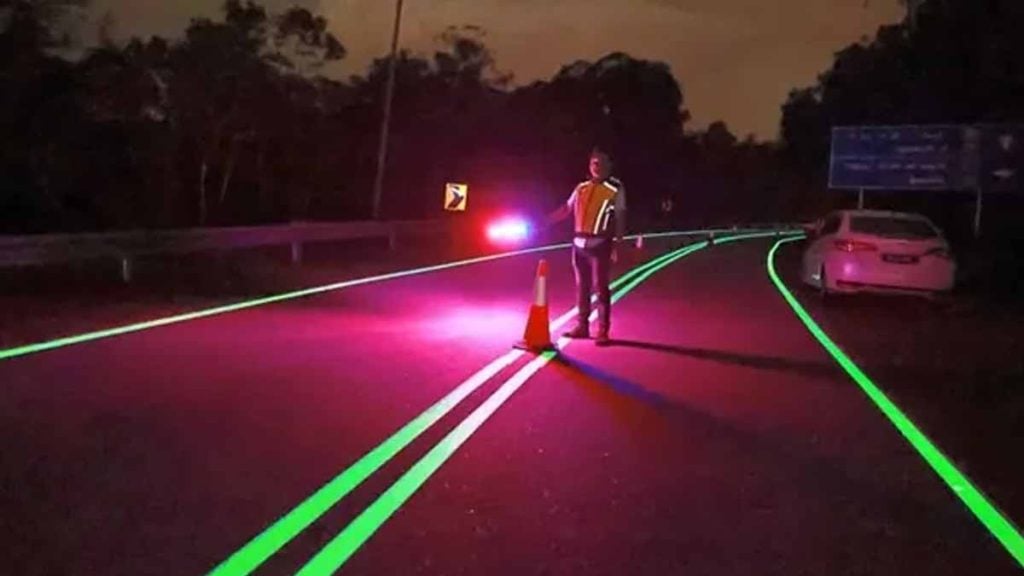
In October 2023, a two-lane stretch near Semenyih lit up for 245 meters using photoluminescent paint. The coating absorbed sunlight by day, then emitted a low glow for up to ten hours after sundown. It targeted unlit roads where power cuts were frequent, so guidance stayed visible even when lamps failed.
Safety needs were stark, because Malaysia records more than 6,000 crash fatalities each year. Many occur on unlit rural corridors where markings fade under rain and fog. Early feedback, reported by The Straits Times, praised crisp lane visibility during storms and mist, while officials noted fewer guesswork moments at night.
Trials elsewhere offered context. Since the early 2010s, the Netherlands and Japan have tested strontium-aluminate pigments on highways and cycle lanes. Those pilots were mostly aesthetic or short. Malaysia’s effort aimed higher: a serious test for underserved regions, with the Public Works Department (JKR) weighing performance against real-world constraints.
How the system worked and where pilots grew
The principle was simple. Strontium aluminate charges under sunlight, then releases low-level luminance without electricity. Painted edges and centerlines formed a glowing guide that drivers could read through rain and spray, because contrast holds when retroreflective beads struggle. Under sparse streetlights, that promise felt tangible.
Public enthusiasm widened the lens. Social posts joked that night lanes looked “really lit,” while many urged broader use on rural highways and village routes. JKR explored additional sites in Selangor and Johor, because early observations suggested the glow remained legible for hours and improved wet-weather cues on roads with poor lighting.
Officials still kept scope tight. The Semenyih pilot was a demonstration, not a blanket swap for streetlamps. Plans to expand required lab tests, on-site audits, and budget reviews. Engineers compared luminance decay, skid resistance, and repaint cycles to conventional thermoplastic lines, because durability and lifecycle costs determine any long-term rollout.
The budget math that sidelined glowing roads
Costs reshaped the story in November 2024. Deputy Works Minister Ahmad Maslan told Parliament the government would not expand the system. According to Paul Tan’s Automotive News, photoluminescent paint cost RM749 per square meter, while standard white markings cost RM40. That near-20x gap dominated deliberations on roads spending.
Numbers affected plans across states. Proposals for 15 locations in Selangor and 31 pilot sites in Johor were shelved after internal reviews. Maslan said trials failed to satisfy ministry experts on performance and value, although the glow impressed many drivers during storms. The premium remained hard to justify at broad scale.
Budget priorities also shifted. Citizens on Facebook and X pressed JKR to fix potholes, sharpen worn lines, and add clearer signage. Officials argued that expanding a high-cost coating would divert funds from those basics. With finite resources, they favored proven measures with wide impact, while keeping room for targeted innovation.
Durability, climate, and questions the lab data raised
Tropical weather challenged longevity. MIROS experts raised concerns about humidity, heat, and heavy rain accelerating pigment decay. The coating’s night output dropped faster than in temperate settings, so maintenance cycles loomed earlier. Frequent reapplication would add materials, labor, and closures, which erodes lifecycle gains on safety interventions.
A 2021 paper in the International Journal of Pavement Research and Technology flagged similar issues. Photoluminescent layers in tropical conditions degraded sooner and often needed new coats within roughly 18 months. That cadence strains budgets, because pigment performance, binder choice, and surface prep all influence how long markings remain readable.
Field reports weren’t all negative. Works Minister Alexander Nanta Linggi said the lines stayed visible for hours, even in wet and foggy conditions. Yet lifespan matters as much as first-month brightness. If tropical wear quickly dulls roads markings, agencies must repaint often, which narrows any energy or maintenance advantage.
What comes next as researchers refine the concept
Malaysia’s pause isn’t the end of the idea. Research teams at Delft University of Technology and Japan’s National Institute for Land and Infrastructure Management are optimizing pigments and binders for higher durability and lower cost. If chemistries improve, price gaps could shrink, and the glow could hold longer through storms.
Meanwhile, pragmatic upgrades can move now. High-contrast thermoplastic with durable beads, better micro-prismatic reflectors, selective solar lighting at curves, and disciplined maintenance deliver immediate gains. Rural corridors benefit when basics are consistent, because predictable guidance reduces night risk without straining budgets across roads networks.
Clear criteria will help future trials. Agencies can define luminance targets, skid values, repaint intervals, and lifecycle thresholds before pilots. Demonstration corridors with independent audits will clarify trade-offs. If costs fall and durability rises, targeted deployments in outage-prone zones might return, this time on evidence that holds over seasons.
Why a careful pause can still move safety forward at night
Malaysia’s experiment sparked useful pressure: make night guidance clearer, cheaper, and tougher in bad weather. The pilot showed promise, yet price and lifespan blocked scale. Staying focused on basic maintenance, while funding better pigments and smart lighting, protects drivers today and invites tomorrow’s breakthroughs—so safer roads never depend on a single idea.