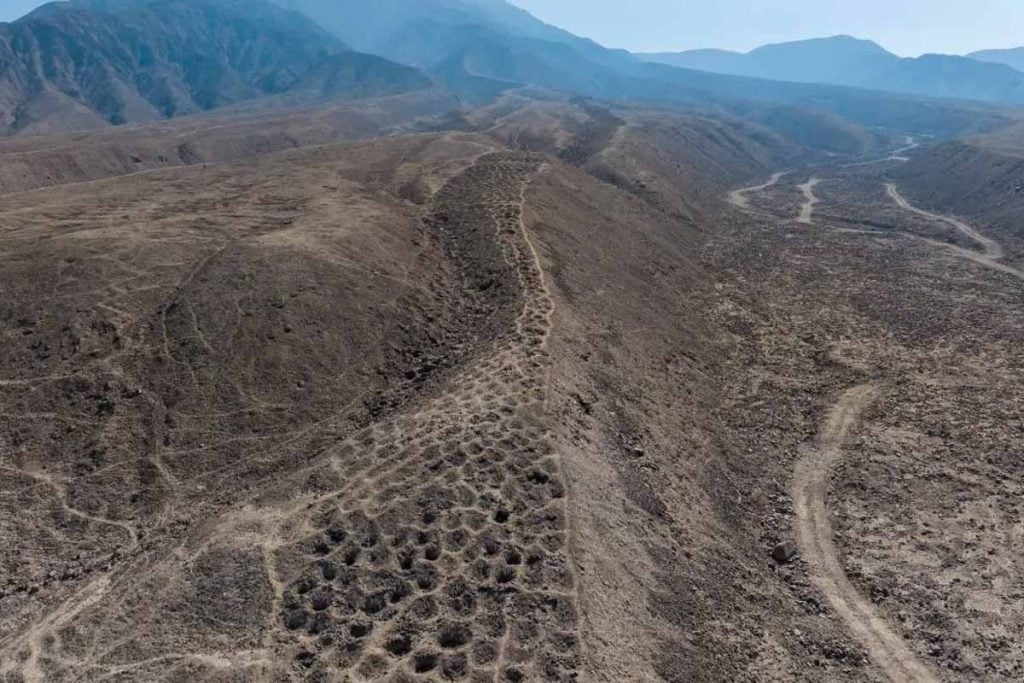
High in thin air, a patterned band of cavities challenges what we think we know. Researchers now sketch a plausible use for the mystery holes, while they leave room for debate. Drone mapping, careful sampling, and comparisons with Indigenous record-keeping point toward trade, counting, and community life, not ritual excess or random erosion. The clues feel practical because the scale, the order, and the nearby routes all fit. The puzzle holds, yet the outline sharpens.
Scale, layout, and setting of the mystery holes
A long band of pits stretches for 0.9 miles, because the makers carved thousands of evenly spaced cavities into Serpent Mountain’s flank. Blocks of a few tens of divots repeat like modular pages, and some pits are rock-lined. Each cavity spans roughly three to six feet across, and descends up to three feet.
The band sits near a defensive settlement, while road intersections run close by. Those thoroughfares predate Hispanic colonization, so the position looks chosen for access and oversight. Layout and location therefore suggest traffic, supervision, and routine activity. The nearby high ground also makes sense for visibility, storage, and order.
Archaeologists first documented the formation in the 1930s, and teams surveyed it in the 1970s. Because the site is isolated, pressure from construction never forced fast conclusions. That slow pace preserved the mystery holes and left a rare chance to test ideas with modern tools, not just speculation or hurried digs.
From Chincha market hub to Inca tribute system
Construction likely began between A.D. 1000 and 1400, while the powerful Chincha Kingdom flourished. Researchers place the population above 100,000, and trade routes threaded the valleys. In that context, standardized blocks and repeated units read like stalls, lots, or counting frames, tied to barter and seasonal exchange.
When the Inca Empire expanded in the fifteenth century, institutions shifted, yet practical systems endured. The band could have been repurposed to track tribute owed by nearby groups. Slight differences in block totals plausibly mirror different obligations. Authority favored visible, auditable order; this site offers both, with terrain that commands movement.
Records indicate continuous local knowledge but intermittent study, so interpretations accumulated. Earlier ideas ranged widely, because function was not obvious. Defense, storage, and accounting sat beside water collection, fog capture, and gardening. Modern methods now refine those options, while the mystery holes still invite caution rather than a single final claim.
Drone mapping, pattern analysis, and khipu parallels
Recent teams flew drones to scan the entire band, and patterning emerged. Sections and blocks repeat with mathematical regularity, as if the mountain carried a ledger. The arrangement resembles gridded storage areas elsewhere in the Andes, because both separate goods, standardize counts, and let overseers check movement quickly.
Researchers compared the layout with khipus, Indigenous devices that record information using knotted cords. Those cords tracked categories and quantities, while grids sort and tally in space. Because both systems support accounting, the parallels matter. Drones turned rugged terrain into a measurable plan, which let analysts test structure rather than guess.
The study appeared Monday (Nov. 10) in Antiquity, and authors linked plan and purpose. They argue that sections could match products or payers, while block totals reflect quotas. Order enables accountability, since standardized lots deter dispute. Within that framework, the mystery holes work like tactile spreadsheets, aligned to roads and watchers.
Botanical clues inside the mystery holes
Sediment sampling revealed pollen from maize inside multiple pits, and maize pollen travels poorly. Because wind rarely carries it far, human handling becomes the likely source. People probably placed produce or containers in the cavities, as traces settled. Botanical remnants therefore support a market or collection role over passive erosion.
Bulrush pollen appeared as well, and communities wove bulrush into baskets. That detail aligns with transport, because baskets move goods and leave fibers or pollen behind. Some pits show rock linings, which protect containers, while temporary plant linings cushion loads. According to the authors, people periodically prepared cavities for deposits.
Study co-authors, including Charles Stanish and Jacob Bongers, stress that multiple clues point together. Grids, roads, maize pollen, and basket plants reinforce a single storyline, while exact procedures stay open. The mystery holes look like stations where goods arrived, paused, and were counted, before officials confirmed quotas or traders finalized exchange.
Competing hypotheses, research limits, and why it matters
Alternative ideas persist, because surface form overlaps with many uses. Defense seems less likely since pits hinder movement, not protect fighters. Water harvesting and fog capture sound creative, yet plant and road evidence pull harder toward commerce. Gardening remains possible in places, although grid logic argues for counting.
Function may have shifted across centuries, while core geometry endured. A Chincha barter hub can evolve into an Inca tribute checkpoint without redesign. Slight block differences could reflect community-level obligations, and nearby routes channel traffic. Because the site avoided modern threats, researchers now test these links with measured confidence.
Broader stakes reach beyond one ridge. The study expands understanding of barter markets, Indigenous accounting, and how landscapes structure interaction. Evidence suggests organized, periodic gatherings where numbers mattered and trust needed tools. In that sense, the mystery holes become a civic technology, while stone, pollen, and routes record the system at work.
What this debate reveals about Andean innovation today
Taken together, the evidence favors a pragmatic story: goods arrived in standardized batches, officials or traders counted them, and communities met obligations in public view. The mystery holes still invite questions, yet drones, pollen, and patterns narrow the field. A ledger cut into a mountain remains a ledger, even as details continue to surface.