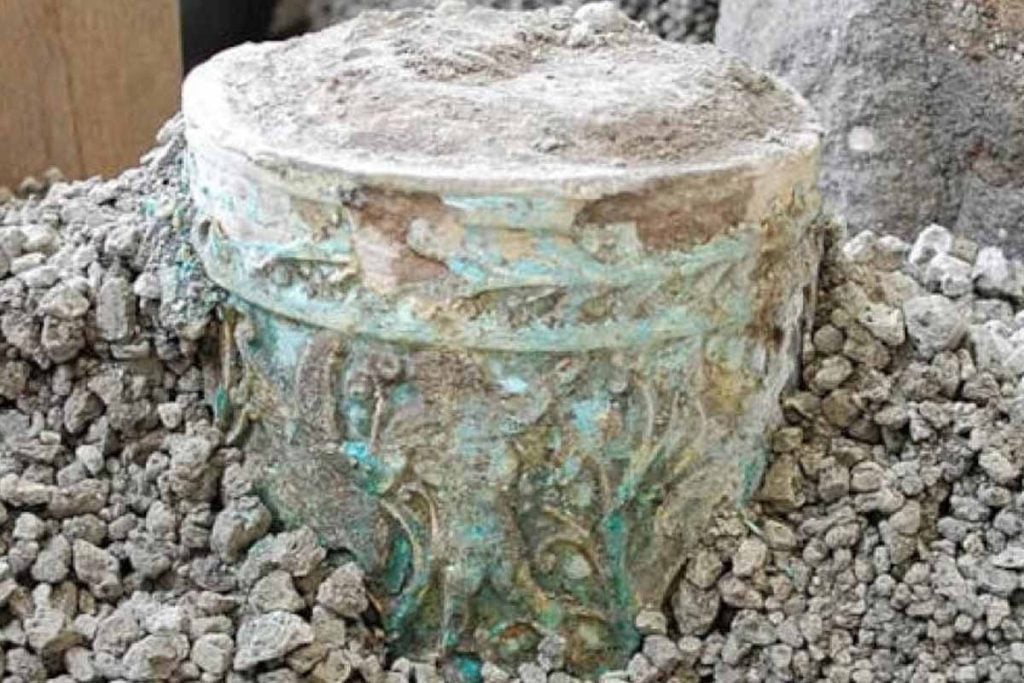
A flash of color surfaced where no one expected it: a refined Egyptian situla of glass-paste faience, painted with Nilotic hunting scenes, resting among everyday tools. Found during conservation in Regio V, this vessel ties Pompeii to Alexandria with disarming clarity, because a luxury object ended up in a working kitchen when 79 AD sealed the room in ash.
An Alexandrian situla in a humble kitchen
The object type was usually decorative, meant for wealthy gardens or reception rooms in Vesuvian homes, yet this example sat on an earthen base beside a central column in a service room. Green and yellow still glow on its surface, where figures—human and animal—move through a lively Nilotic composition inside a practical workspace.
It shared space with mortars, pans, and storage containers used for routine tasks. That contrast does not diminish its value; instead, it charts an object’s shifting biography as roles change with owners and needs. Ongoing analyses may reveal traces of contents, whether an imported ingredient or something local, tucked inside its elegant walls.
Nearby finds complicate the scene in revealing ways. Terracotta votive figures, a marble object, and a bone pin carved with a female figure cluster near what appears to be a small domestic shrine. Cooking and devotion coexisted in close quarters, and visual languages from Egypt and Italy mingled without friction in this compact room.
Inside Pompeii’s Thermopolium of the Rooster
Excavations from late 2023 to May 2024 focused on the service area beside the counter known from the Thermopolium of the Rooster. The workspace was strikingly organized: distinct zones for amphorae and liquids, separate areas for processing and cooking, and a small bathroom that opened toward the Vicolo dei Balconi.
Amphorae recovered here came from several Mediterranean regions, demonstrating trade networks that reached even modest commercial kitchens. Supplies flowed through these routes, then landed behind the counter, where staff turned shipments into fast servings. A venue built for speed still records those exchanges, because containers and tools stayed where hands last placed them.
The director, Gabriel Zuchtriegel, underlined a permeable cultural world. Egyptian objects furnished both kitchen and domestic shrine areas, showing how eastern aesthetics and religious ideas traveled well beyond elite parlors. A popina was not merely a sales point; it also spread fashions and symbols, even as it served customers until the final hours.
From garden ornament to kitchen container
Luxury in a kitchen sounds misplaced, yet reuse was pragmatic. When a container was needed, a decorative vessel could serve without ceremony. That choice adds meaning rather than erasing it, because the situla carries layered roles at once—ornament turned tool—while still speaking to taste shaped far from this back room.
The situla’s colors remain vivid. Green and yellow bands frame energetic scenes with hunters, animals, and plants. The surface looks animated amid soot-darkened equipment, and the earthen base plus the central column provided a stable perch. The find’s position suggests someone placed it for convenience, where reach and routine mattered most.
Other pieces hint that this situla was not the only exotic presence. Terracotta votives, the marble object, and the carved bone pin point to ritual attention at the margin of labor. A small shrine within a kitchen narrows any divide between sacred and ordinary, folding practice into the cadence of daily preparation.
Repairs, routines, and a two-story plan
Earthquakes that struck in the years before the eruption forced repairs. Workers installed horizontal poles and placed a limestone column centrally to support the upper floor, while some fixes look hasty and economical. Tight margins did not halt service, because meals still needed to be prepared, sold, and carried into the street.
The building had two stories. Commercial rooms occupied the ground floor, and modest quarters sat above. Efficiency guided the plan: clear storage for liquids, defined areas for cooking and processing, and short paths between tasks. A small bathroom opened onto the Vicolo dei Balconi, balancing convenience with the constraints of a cramped site.
Upstairs presented a different register. One chamber retained Fourth Style frescoes with illusionistic architecture and a striking yellow floor. Furnishings likely bore polychrome marble facings, and personal items rested in wooden caskets. Bronze decorative elements survived, alongside glass unguentaria and bone pins, suggesting refined tastes above the relentless pace below.
Preserving Pompeii’s stories for visitors now
Recent maintenance restored walls and decorative schemes noted by earlier campaigns. Teams added removable protective roofs designed to harmonize with the setting, and they improved lighting to highlight textures, colors, and volumes. As a result, the rooms read clearly again, yet they keep the fragile patina of activity halted in an instant.
Stabilization protects knowledge in the long term. With the rooms shielded, specialists can study residues, pigments, and tool marks at a careful pace. As reports emerge, details about circulation, reuse, and shrine practice sharpen. The Thermopolium begins to look like a finely tuned machine, built around calibrated zones and efficient pathways.
Within that matrix, the Alexandrian situla sits quietly at the center of many threads. It anchors discussions of trade, taste, and everyday devotion. It also shows how an object’s meaning thickens as it moves, gathering new functions while never fully shedding the old ones that once defined its status.
A renewed look at why this kitchen still matters
This find does not just add a pretty object to a catalog; it adds context to routine. A luxury piece worked beside mortars and pans, while shrine traces sat within arm’s reach of storage jars. Within a two-story plan under repair, a busy team kept serving, and the room kept its secrets until now.