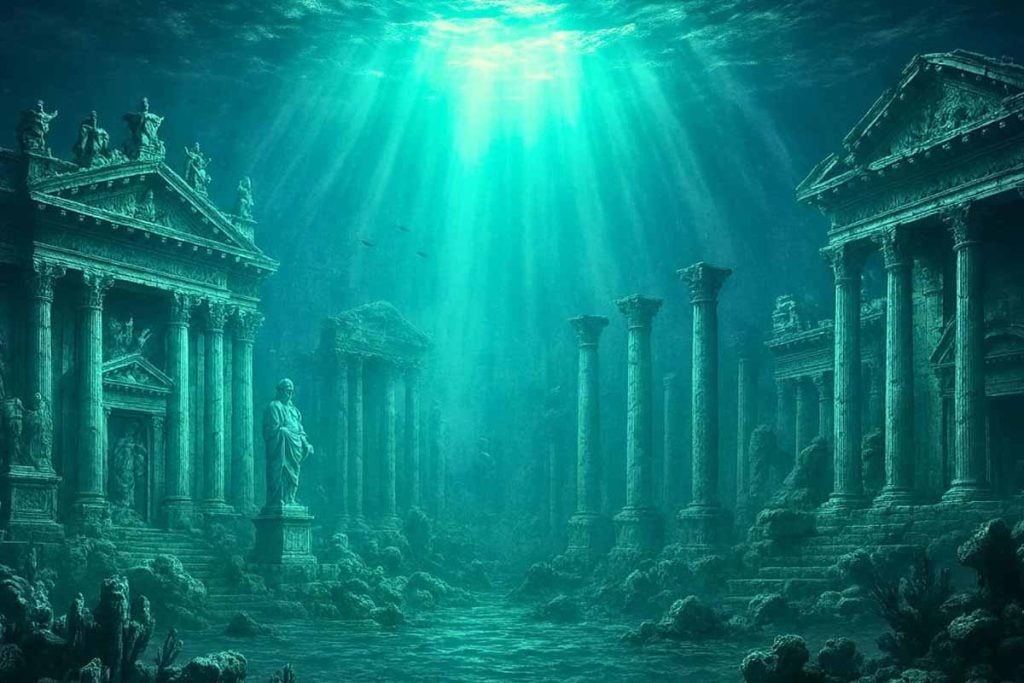
A silent world reappears when light cuts through cold water, and walls emerge from silt. The first finds suggest artisans, scholars, and traders once shared the same shoreline, even as mountains watched. An Atlantis-like metropolis seems to surface through shards, bricks, and beams, while unanswered questions gather. Investigators follow traces patiently because every carved stone, vessel, and ritual clue narrows the mystery. The story begins near the shallows, yet it reaches centuries deep.
Issyk Kul’s hidden city, location and first clues
Four underwater zones hug a northwest shoreline, mapped at shallow depths between three and thirteen feet. Explorers from the Russian Academy of Sciences noted flooded foundations at Toru-Aygyr and everyday tools in situ. A millstone still lies where grain once turned, so work, fatigue, and bread feel close. This drowned metropolis whispers through fired bricks, collapsed stone frames, and preserved beams that hold their geometry despite the lake.
Nearby, survey teams documented a public building’s footprint and argued it matched communal life. The plan and materials suggest a mosque, a bathhouse, or a school known as a madrassa. Social rhythms align with these structures, because teaching, prayer, and hygiene anchor urban time. Streets likely converged here, and commerce passed the threshold while voices answered calls.
Across the other zones, clues stack into patterns that signal a city, not a camp. Mudbrick appears as round and rectangular units, which implies planned layouts and different uses. A 13th-century Muslim necropolis anchors memory, while earlier burials show continuity. Skeletons face north with faces toward the qibla, so ritual law guided grief.
Clues that this metropolis once thrived along the Silk Road
Traders once rode east and west as the Silk Road accelerated cultures from the second century BC. The lake’s rim hosted exchanges of silk, spices, and precious metals, and markets doubled as newsrooms. Ideas traveled with caravans, because belief, craft, and politics share space. A major hub stores such density; the ground still releases its receipts.
Expedition leader Valery Kolchenko describes a large commercial agglomeration, while funding from the Russian Geographical Society sustained dives. Work proceeds in grids, since careful mapping protects context and chronology. Artifacts now move to labs for analysis, and organic traces will undergo accelerator mass spectrometry. Radiocarbon dating sets precise ages, so timelines harden rather than drift.
Teams photographed walls before lifting fragments, because movement can erase meaning. Ceramic vessels, structural timbers, and shaped stones matter differently, yet together they draw reliable maps. Researchers match tool marks, mortar, and grain residues with known workshops. When methods converge, confidence grows, and the living outline of a medieval metropolis comes into focus.
Rituals, structures and what the graves still reveal
Burials preserve orientation and belief even when roofs collapse and streets vanish. Here, bodies lie facing north, and faces turn toward the qibla, which confirms Islamic practice. A necropolis beside homes suggests proximity between everyday life and remembrance. The rhythm of prayer and trade likely braided through alleys and courtyards.
Public buildings create civic glue because they host learning, hygiene, and worship under shared rules. A suspected madrassa indicates scholars, while a bathhouse implies infrastructure and steady fuel. A mosque means time was measured communally, and announcements ordered days. Small finds, including vessels and beams, attach hands to plans.
Round and rectangular mudbrick units point to specialized roles, while fired bricks indicate durable investment. One structure held a millstone, so grain arrived, stone turned, and flour left. Food economies stabilize households, yet they also tax, pay, and store. Across rooms and yards, the city’s metropolis-grade complexity becomes legible.
How an earthquake drowned the metropolis and reshaped the shoreline
Kolchenko compares the early 15th-century disaster’s scale to Pompeii, because suddenness defines memory. Evidence points to abandonment before the shock, so lives were spared, yet neighborhoods fell. After the quake, population patterns changed quickly, and nomadic groups replaced the settled order. Today, small villages edge the water where avenues once ran.
Geology frames loss as well as survival, while lake level shifts finish the work. Issyk Kul has risen since ancient and medieval times, which helps explain submerged ruins. The lake lacks a known outflow, although some propose a deep underground channel. Tianshan peaks surround the basin, and snowmelt feeds its bright expanse.
Numbers clarify the setting without dulling wonder. The lake reaches a maximum depth of 2,192 feet, or 668 meters. It stretches about 182 kilometers long and nearly 60 kilometers wide, which expands horizons. Shallows can hide cities when levels climb, and silt seals rooms. Underwater, collapsed masonry still marks the drowned metropolis.
Scale of the lake, geology and unanswered scientific questions
Fieldwork always meets limits, even as methods improve and archives grow. Accelerator mass spectrometry will date organic traces precisely, which secures anchors for phases. Stratigraphy, tool marks, and ceramic typologies then connect those anchors to neighborhoods. As sequences settle, the city’s lifespan narrows, and debates shrink.
Comparisons widen perspective and keep imagination disciplined while curiosity stays brave. Britain’s Ravenser Odd, the “Yorkshire’s Atlantis,” shows how weather and water consume towns. Storms sunk that medieval port, just as seismic forces remade this shore. Different agents, similar erasures, and shared human adjustments point to recurring patterns.
Plato’s famous island still inspires debate, while most scholars call it a philosophical fiction. Yet legends endure because ruins surface and stories rhyme across continents. Here, evidence ties directly to trade, ritual, and learning under mountain light. Streets fell silent, yet shoreline villages continue daily life beyond the vanished metropolis.
Why these submerged ruins change our view of Central Asia
The finds recast a high-altitude shore as a crossroads where trade, faith, and study met the mountains. An earthquake ended the built order, yet memory persisted in ritual orientations and durable masonry. As labs fix dates and specialists align strands, the picture sharpens. The pieces reassemble into a metropolis, dense with exchange and ritual, its edges blurred by time.