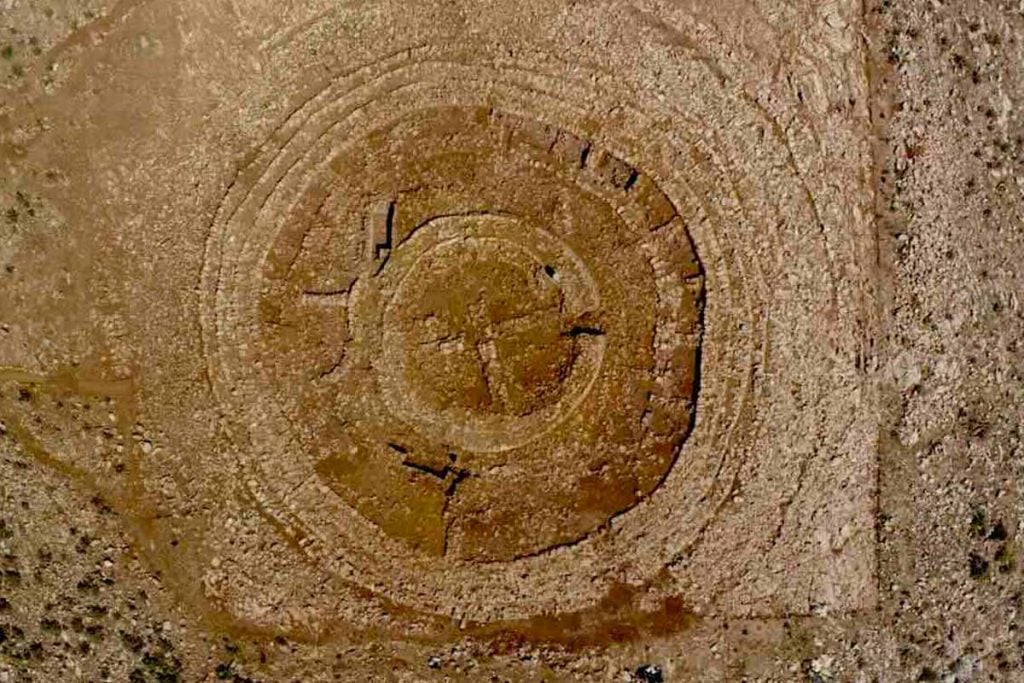
A ring of stone on Crete’s Papoura Hill is stirring old myths and new debate, because its scale and design feel uncannily close to the Labyrinth. Archaeologists uncovered a circular Minoan monument whose form, story echoes, and timing now attract major awards and scrutiny. The find invites fresh eyes on Minos, the Minotaur, and a building tradition that may explain why legends endure when ruins, layers, and questions remain, still unanswered.
Papoura Hill’s circular monument and what sets it apart
A chance find last June on Papoura Hill surfaced during radar works for the New International Airport of Heraklion near Kastelli. Greek authorities judged the site’s value greater than deadlines, so construction paused and digs began in 2024. That call reset schedules and budgets, because the structure already defied expectations.
Archaeologists mapped a great circle, near fifty meters across and about 1,800 square meters in area. Eight stone rings step at different elevations, and a central element, labeled Zone A, anchors the plan. The geometry feels experimental for its time, with no clear Aegean parallels documented.
Early notes suggested a near-conical profile, while narrow openings tied oddly placed spaces into tighter sequences. These patterns read almost Labyrinth in plan, yet teams stayed cautious. They compared the shape to circular buildings from Mesopotamia, Oman, and Syria in the early Bronze Age and kept testing that analogy.
Myth and stone: how the Labyrinth story frames the find
Greek tradition says Daedalus built a maze for King Minos to confine the Minotaur. Theseus ventured inside, killed the beast, and found daylight again thanks to Ariadne’s thread. The tale survived in poetry, art, and schooling, while scholars debated which details reflected lived practice and which belonged to metaphor.
Excavations in 2024 revealed a monumental circle at Papoura Hill that echoes that world. Archaeologists stress caution, yet the plan’s nested rings, shifting levels, and controlled passages recall an ordered subterranean domain. The comparison sharpened language and aims, because the team could test ideas against a physical Labyrinth analogue.
Recognition followed. The project received the Archaeologist of Palmyra Award for Best Archaeological Discovery of 2024, formally honored in Paestum, Italy, at the International Archaeological Tourism Exhibition, as reported by Greek Reporter. Earlier, Costas Paschalidis called the site one of this century’s most important archaeological finds.
What the structure changes for Minoan archaeology
The plan forces scholars to revisit assumptions about Minoan monumentality. Circular architecture now sits center stage, not just as a shrine variant but as a complex, multi-ring machine. Field teams adjust sampling, because unusual circulation patterns require tighter spatial control and deeper recording across levels and links.
Construction for Heraklion’s new airport paused, since officials weighed economic timelines against heritage obligations. The site became a teaching case on rescue archaeology, legal safeguards, and stakeholder communication. Public interest grew rapidly, while institutions emphasized patience, because headlines travel faster than excavation diaries and might outpace stratigraphy.
Method guides stress restraint. Interpretations stay provisional until surfaces, fills, and interfaces tell a consistent story. Teams cross-check analogies with regional datasets and material traces. The site invites bold thinking about the Labyrinth, yet good practice demands measured claims that distinguish mythic framing from evidence tested in trenches.
Numbers, rings, and geometry that suggest a Labyrinth logic
Measurements anchor the debate. The structure spans nearly fifty meters and covers close to 1,800 square meters. Eight stone rings step across varying heights, while a named center, Zone A, organizes flows. Archaeologists note that prehistoric Crete offers no true Aegean parallel with this scale and configuration.
Comparative files list circular buildings from Mesopotamia, Oman, and Syria in the early Bronze Age. Those analogies stay cautious, because functions differ across landscapes, economies, and rites. Yet the nested plan encourages route control and staged movement, which fits a conceptual map that modern readers call a Labyrinth.
Damage complicates reconstruction. Some segments imply a near-conical silhouette, while irregular spaces link through narrow openings. These relationships can choreograph arrival, pause, and exit, so behaviors stack over time. Because details matter, teams log elevations and interfaces carefully and then test each spatial claim against layers.
Recognition, institutions, and why visibility now matters
Visibility shapes research momentum. Greece’s culture minister, Lina Mendoni, said the Palmyra Award honors an exceptional excavation. The prize was presented in Paestum, Italy, during the International Archaeological Tourism Exhibition. Greek Reporter covered the ceremony, which lifted the project’s profile and broadened its support network beyond Crete.
Awards do not settle arguments; they focus attention. Costas Paschalidis, who heads the Association of Greek Archaeologists, earlier called the Papoura complex one of this century’s most important finds. That statement sharpened expectations while reinforcing the need for transparent methods and shared access to records and samples.
Tourism boards see opportunity, yet planners tread carefully around airports and heritage. Because the site spurred debate about the Labyrinth, leaders balanced development goals with conservation and education. Stakeholders coordinate messages and security, while curators plan exhibits that respect evidence. Local schools craft programs linking myth, place, and science.
Why this story still matters as evidence gathers
The Papoura Hill monument asks for patience and curiosity in equal measure. Its rings, steps, and passages give scholars a working model, while measured language keeps claims honest. Awards add light, not answers, and public interest adds urgency, not shortcuts. If research holds, the Labyrinth becomes less of a riddle and more of a map guiding future questions, because careful comparisons, stratigraphy, and open data will show which paths truly connect.