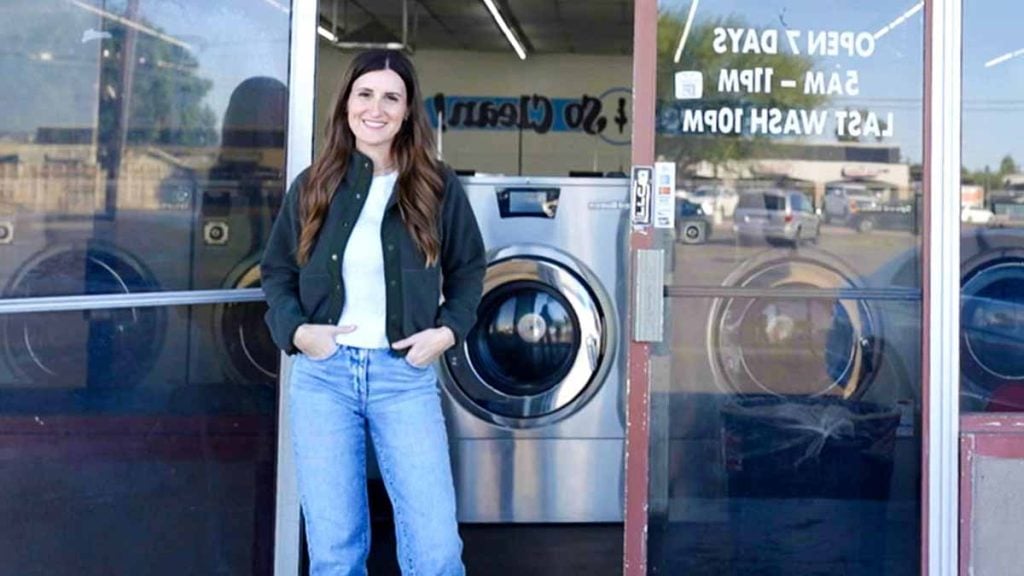
On a mild Arizona winter day, Cami left hospital shifts for a bustling laundromat. It felt less risky than it sounds. She spent thirteen years on a bone marrow unit. She bought a neighborhood shop in October 2020, then left nursing in April 2023. Today she schedules five to six hours a week. She protects weekends and holidays. A small crew manages counters and delivery runs. That leaves room to grow and to share what works on short videos.
How a laundromat replaced the hospital shift
From October 2020 to April 2023, Cami balanced two careers, working near full-time as a nurse. She built a steady shop. Now she steers the laundromat five to six hours a week, a sharp shift from the early grind. Back then, every spare shift and late evening went into growth.
She hired a lean team—six people, including one part-timer—to run counters, wash-and-fold, and route pickups. With staffing in place, her focus shifted toward systems and marketing rather than mopping floors. The day’s rhythm still hums, yet her time is spent on choices that move the business forward.
Alongside operations, she spends ten hours a week posting videos about process, pricing, and service. It multiplies reach and trust, though she misses hospital camaraderie. Just as important, she enjoys freedom she lacked in healthcare: holidays at home and weekends off. She can take spontaneous trips without asking a supervisor.
From home sale to closing: financing the purchase
To buy the business, she sold her house for $310,000 in April 2020, clearing $150,000 in equity. She moved into a rental. She added $50,000 in savings and, in October, put $200,000 down on a $300,000 deal. A mentor told her “laundromats scream money” as the two-decade-old shop already cash-flowed.
The remaining $100,000 was seller-financed at 6% over two years. She paid it off in about eighteen months. Renovations—new lighting, fresh paint, better flooring—cost roughly $20,000 and made the laundromat feel warm. Those quick wins improved curb appeal and kept older equipment earning while bigger upgrades waited.
To support pickups and large loads, she financed washers and vehicles with four loans, now totaling about $4,900 a month. Debt service sits inside weekly cash planning. Because fixed payments stay predictable, she can tune prices and promotions without risking the margin needed for payroll and maintenance.
Pricing, services and how a laundromat makes money
Revenue last year reached about $475,000. A neighboring salon added nearly $30,000 in rent. After expenses, profits were roughly $119,000; she paid herself $66,000 and reinvested the rest. The laundromat now runs lean, with staff driving throughput. She watches unit costs, payroll, utilities, and detergent as the core levers.
Pricing spans quick-turn dryers at twenty-five cents per seven minutes to heavy-duty eighty-pound washers at $12 per load. Pickup and delivery vary by job and route. Because volume swings by hour and season, she uses simple specials to smooth demand. That keeps machines loaded through slower periods.
Content doubles as marketing. Six months of short-form posts in 2024 brought about $22,000, and she projects around $200,000 in 2025 as partnerships grow. Those clips show real work, service standards, and transparent pricing. They keep new customers arriving without big ad buys or aggressive coupons daily.
Learning the trade, scaling, and industry benchmarks
With no leadership background, she built skills on the fly. She studied operations through podcasts and books. She attends one or two industry conferences each year. The goal stays simple: work on the business, not inside it. Systems, training, and scheduling take priority over folding towels during rushes.
Benchmarks keep expectations realistic. According to the Laundry Association, the average laundromat can throw off $15,000 to $300,000 in annual cash flow. Market values range from $50,000 to more than $1 million. Across that spread, disciplined pricing, clean stores, and dependable machines usually separate top performers, often.
Her plan tracks two paths. She could retire in six to seven years. Or she could keep ownership and hire a manager for daily work. Either route relies on steady throughput and smart reinvestment. Staff development keeps the shop improving even when she spends fewer hours onsite.
Freedom, next moves, and why the model keeps working
The appeal is lifestyle as much as margin. She says this is the first time she can be home for every holiday and keep weekends free. Because no boss approves time off, she can catch a last-minute flight to see family. She resets without juggling shift swaps.
Stability also matters. She bought a new house in April 2023, once the shop’s cash flow felt reliable. Staff handle deliveries and route logistics, with vehicles dedicated to pickup and drop-off. That base lets her test new services carefully while guarding the core customer experience at the laundromat.
Next steps may include acquiring a second site—or building one from scratch—then growing it for resale. She could also keep the shop and hire a manager to run daily operations. She frames expansion as a game: learn faster, scale cleanly, and keep risk measured while skills, systems, and confidence compound.
What this path shows about time, cash flow, and choice
Her story shows how steady systems can buy back time. She swapped shifts for ownership, trained a small team, and let clear prices, clean service, and simple marketing do the heavy lifting. Because the laundromat runs on routines, she can choose growth or step back without losing momentum. The path is not flashy, yet it rewards patience, care, and consistent reinvestment.